

Climate and Environment Dashboard
Together, we’re taking action
Calgary is on a journey to become a climate-resilient, net-zero and environmentally-sustainable city. This means enhancing quality of life today, strengthening community safety and well-being and creating a city where future generations can thrive. Calgarians, businesses and industries are working together to make measurable, lasting change.
Explore how far Calgary has come across key outcomes in the charts below. Hover over each chart to see the details. Accessible data is also available for each chart.

Water Conservation
Water Conservation
Securing our water supply for a growing city
The Bow and Elbow rivers provide Calgary with a stable water supply and active water management is essential as the city continues to grow. Calgary committed to reducing water consumption by 30 per cent over 30 years, 2003 to 2033.
Between 2003 and 2023, Calgarians cut per-person water use by 31 per cent through water conservation and efficiency, achieving our target a decade early while the city rapidly grew.
Flood Risk Reduction
Flood Risk Reduction
Protecting our communities from river flooding
Calgary is a river city and flooding conditions are expected to increase as our climate changes. The City of Calgary has partnered with the provincial and federal governments, industry, Non-Governmental Organizations and Calgarians and invested in upstream dams, barriers and outfalls to build flood resilience.
Since 2013, we've reduced the number of properties at risk of river flooding by 81 per cent, helping to keep homes, businesses and infrastructure safe.
Urban Forest Growth
Urban Forest Growth
Greening our city for healthier, more livable communities
As Calgary grows and experiences more severe storms, trees and green space are lost, reducing both tree diversity and the city’s natural cooling and shade. To reach Calgary’s urban canopy target of 16 per cent by 2060, more trees need to be planted on both public and private land. The City committed to planting 1.3 million trees on public land by 2035.
Since 2024, tree planting on public land has reached 273,426 trees, achieving 21 per cent of the target. This is helping to cool and green neighbourhoods and enhance liveability.
Renewable Energy
Renewable Energy
Powering our community with renewable energy
Calgary needs to meet its growing energy needs and reduce its greenhouse gas emissions. Calgary has a target to offset 15 per cent of residential electricity use with rooftop solar electricity generation by 2030, this equates to an estimated 600,000 kW of installed capacity. This 600,000 kW target for 2030 is subject to change based on changes to the forecasted residential electricity consumption in 2030. Solar energy, along with other renewable sources are growing, however with approximately 2.3 per cent of residential electricity use in Calgary now offset by rooftop solar PV, we remain a long way from what's needed to meet climate targets.
Since 2019, rooftop solar adoption has grown rapidly with 83,900 kW installed, a 1500 per cent increase in 6 years, reaching 15 per cent of the residential rooftop solar generation target. This means more homes are generating their own solar energy and reducing utility costs.
Key metrics across various areas of action help us track our progress.
Our shared climate and environment goals
Calgary has three interconnected goals: build climate resilience, reach net-zero by 2050 and advance environmental sustainability. We're working toward these goals by reducing greenhouse gas emissions and improving energy use; building infrastructure and communities that withstand climate impacts; and protecting nature and fostering healthy communities.
Calgary’s path forward
To advance Calgary’s climate and environment goals, we've established focus areas that organize related priority actions under common themes. Together, these focus areas show how coordinated and targeted efforts across the city contribute to climate resilience, greenhouse gas emissions reductions and environmental sustainability.
Land acknowledgements
We appreciate and acknowledge that we are on the ancestral and traditional territory of the Blackfoot Confederacy, made up of the Siksika, Piikani, Amskaapipiikani and Kainai First Nations; the Îethka Nakoda Wîcastabi First Nations, comprised of the Chiniki, Bearspaw and Goodstoney First Nations; and the Tsuut'ina First Nation. The city of Calgary is also homeland to the historic Northwest Métis and to the Otipemisiwak Métis Government, Métis Nation Battle River Territory (Nose Hill Métis District 5 and Elbow Métis District 6). We acknowledge all urban Indigenous people who have made Calgary their home.
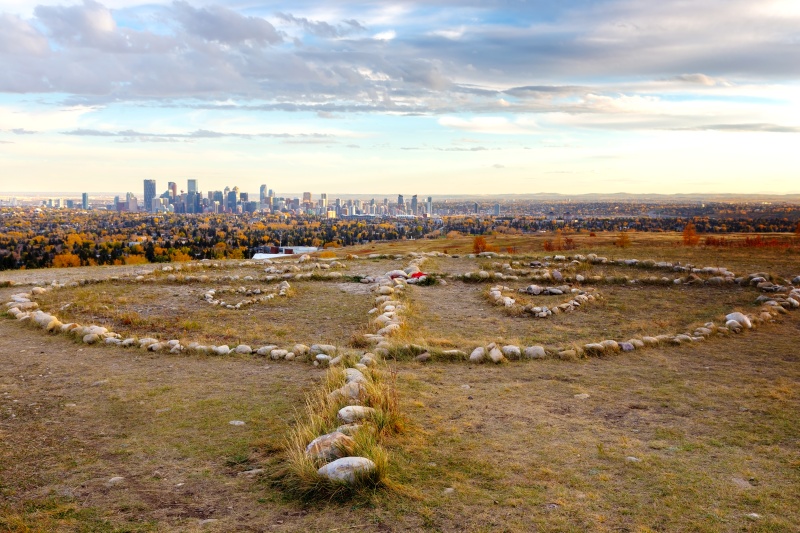
Honouring the land and its legacy
Calgary, where the Bow and Elbow rivers meet, has always been a place where people come together to share ideas and opportunities. Indigenous peoples have cared for the land and resources for generations, and their knowledge continues to guide how we protect air, water, wildlife, ecosystems and natural spaces. Today, we have a shared responsibility to safeguard our environment and take climate action.
Watch video – Together we can