

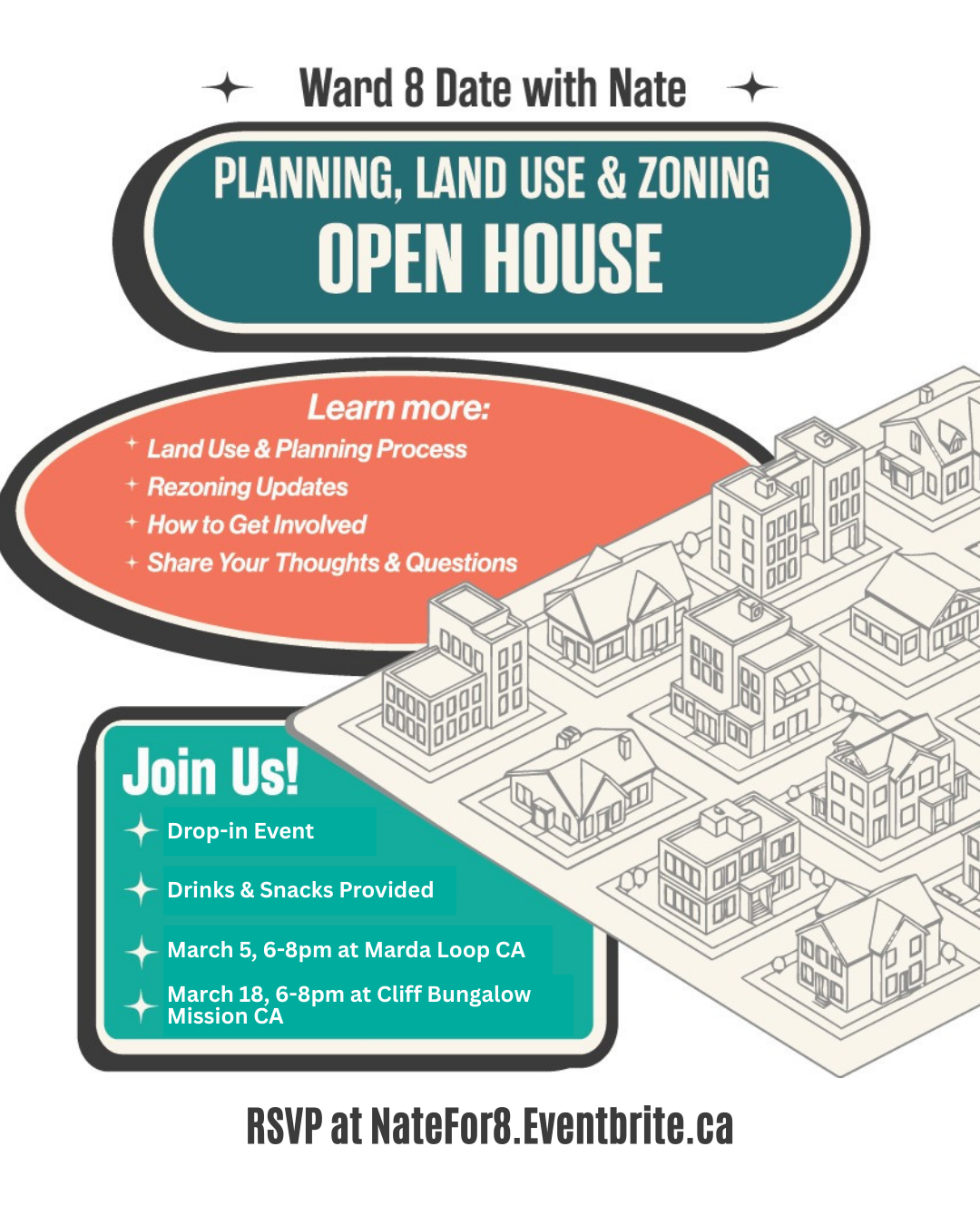
Ward 8 Date with Nate - Planning #2 and 3: March 5 and 18 (Updated)
Overview
Dear Ward 8 residents,
On December 15, 2025, City Council voted to proceed with a Public Hearing on the repeal of city-wide rezoning, with a date now set for March 23, 2026.
More information about Public Hearings on Planning Matters can be found on the City website. You can make a comment, or pre-register to address council by submitting through the online portal.
I know this is an issue important to many Ward 8 residents which is why our team is hosting a series of three townhalls on housing and rezoning.
These are the first in an ongoing series of townhalls we plan to host over the next four years on all municipal issues titled “Ward 8 Date with Nate.”
All Ward 8 Dates with Nate are an opportunity to ask questions, share your thoughts, and chat with my team and I in a relaxed setting.
Our next Ward 8 Date with Nate will be March 5 in Marda Loop. The next one will be March 18 in Cliff Bungalow/Mission.
We are asking all those interested to RSVP at least 24 hours before the event to save your spot.
What We Heard: Feedback from the Open Houses
April 7, 2026
Thank you to everyone who attended the Marda Loop Open House on March 5 and the Cliff Bungalow Mission Open House on March 18 and shared feedback. Residents expressed a wide range of views, but several clear themes emerged around how growth is experienced and what needs to happen moving forward.
Prompts That Framed the Open House
What We Heard: March 5
1. Protecting What Makes Our Neighbourhoods Livable
Residents consistently emphasized the importance of protecting parks, green space, and tree canopy as the community grows. Walkability, traffic calming, and pedestrian safety—especially for seniors and families—were also top priorities. Many highlighted the need to invest in community amenities such as schools, recreation centres, and gathering spaces to maintain a strong sense of neighbourhood connection.
2. Affordability Pressures Are Real
Many participants shared personal experiences with rising housing costs, including friends and neighbours being displaced and younger people struggling to buy or stay in the community. Residents expressed concern that new development is often expensive and does not always result in housing that feels truly affordable or suitable for families. There was strong interest in a wider range of housing options, including family‑sized units, co‑operative housing, and non‑market housing.
3. Support for Density — When It Aligns with Community Expectations
Feedback showed that residents are not opposed to density in principle. Many support growth when it is planned intentionally, respects neighbourhood context, and avoids over‑concentration on individual streets. Clear expectations around building height, lot coverage, and transitions between different housing types were frequently mentioned as important.
4. Infrastructure Needs to Keep Pace with Growth
A common concern was that development is moving faster than infrastructure. Residents raised issues related to transit capacity, school availability, traffic, parking, and pedestrian safety. Many stressed that adding new housing must be paired with upgrades to services and infrastructure to ensure long‑term livability.
5. Design Quality and Accountability Matter
Residents raised concerns about construction quality, loss of privacy, and impacts from high lot coverage and rapid redevelopment. There were repeated calls for stronger design standards, better enforcement, and clearer accountability for developers—particularly around construction impacts and long‑term building quality.
6. Engagement and Fairness in Decision Making
Many residents shared concerns about fairness in how growth and change are being experienced across communities. People spoke about uneven distribution of density between neighbourhoods and questioned whether all communities are being asked to carry the same level of change. There were also thoughtful reflections on whose voices are most able to participate in engagement processes, with some residents feeling that barriers to time, access, or information can leave certain perspectives underrepresented. At the heart of these comments was a desire for more equitable outcomes and decision-making that feels fair to all communities.
What We Heard: March 18
1. Growth Is Happening Fast
Many residents feel change is happening quickly and without enough coordination. Concerns were raised about aging infrastructure—including water, power, streets, and parking—and whether these systems can handle additional pressure before upgrades are made.
Residents also emphasized the importance of sharing growth more evenly across the city, rather than concentrating impacts in the same neighbourhoods.
2. Heritage, Trees, and Neighbourhood Character Matter
Protecting heritage buildings, mature trees, and established neighbourhood character was a strong and consistent message. Residents expressed concern about permanent losses to tree canopy, green space, and heritage homes, and stressed the importance of setbacks, scale, and compliance with existing rules so new development fits the surrounding context.
3. Safety, Traffic, and Parking Affect Daily Life
Residents raised concerns about increased traffic, unsafe streets, and reduced pedestrian and cycling safety. Parking shortages linked to new development were frequently mentioned, along with construction impacts such as vibration, noise, and damage to nearby homes. People want streets that feel safe and livable for everyday use.
4. Design Quality and Accountability Need Improvement
Many participants expressed frustration with poor design outcomes and felt that some new buildings do not reflect the character of the community. There was a call for higher design standards, better landscaping, and clearer accountability for developers—especially around construction practices and long‑term impacts.
5. Affordability Is a Serious Concern
Residents widely acknowledged that housing affordability is a real challenge. People shared experiences of being priced out, seeing younger family members leave the city, or struggling to find suitable housing. At the same time, there was skepticism about whether current development patterns are delivering truly affordable homes, especially when redevelopment increases land values.
6. Engagement Feels Too Late in the Process
Many residents felt community input comes too late to meaningfully influence decisions. There was a desire for earlier, more transparent engagement and for neighbourhood voices to be better reflected in policy and planning decisions.
Moving forward
Overall, residents shared a hope for growth that feels better aligned with community expectations and rooted in care for the people and places that make neighbourhoods unique. There is a strong desire to see change guided by livability, local character, and long-term well‑being. Many also expressed appreciation for clear, open communication and opportunities to feel genuinely heard as neighbourhoods continue to evolve.
We plan to use this feedback to propose and shape solutions to the challenges our city and communities face moving forward. If you have any questions, please reach the Ward 8 team at ward8@calgary.ca.
- Ward 8 Team
Categories: Events