

Conceptual Streetscape
To address the specific needs and goals of each character area, the design proposed three distinct streetscape typologies.
These typologies, while tailored to their respective character areas, work together to create a cohesive and connected Avenue.
Learn about the three diverse character areas
The project boundary includes Stephen Ave/8th Avenue, from 11th Street S.W. to 1 Street S.E.
Click to enlarge image.
Types of streetscapes
Shared street
1 Street S.E. to 5 Street S.W.*
Located within the historic and commercial core, directly connected to key arts and civic functions, the Shared Street acts not only as an integral Downtown link, but a primary public space in its own right.
The Shared Street will be highly walkable and bustling with public life.
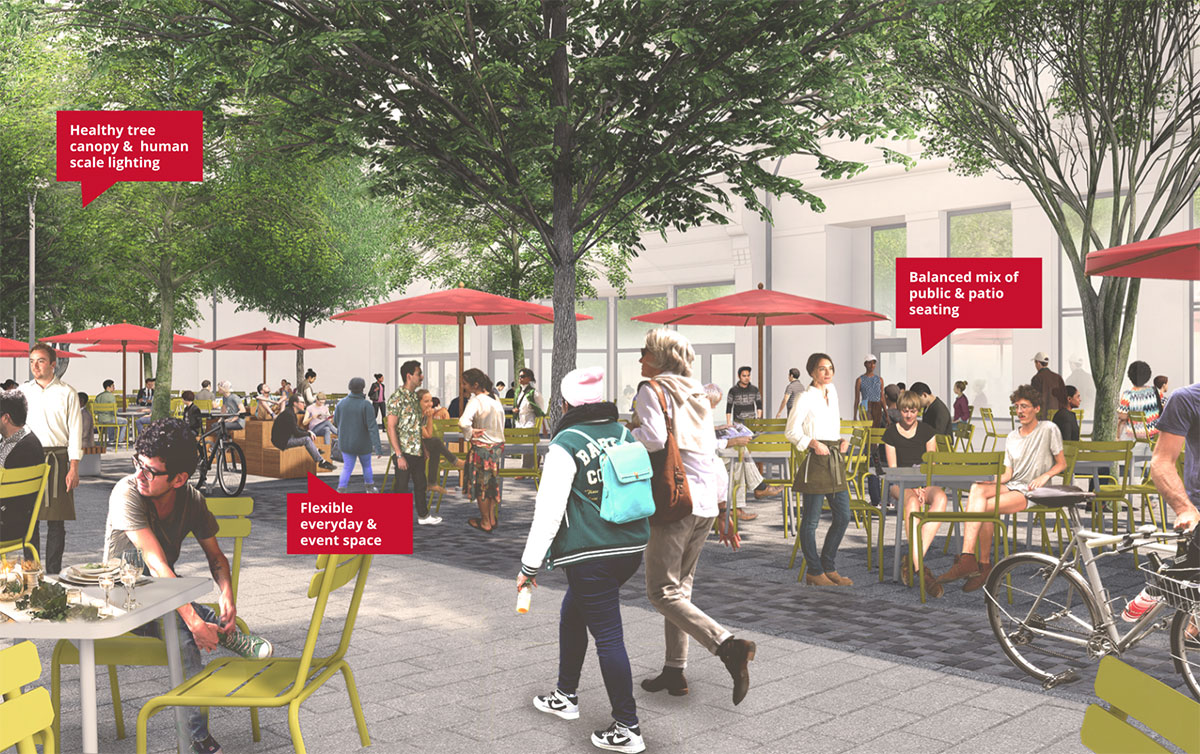
Please note this is a concept design to show general design and uses. Final placement of features and amenities will be determined in the detailed design stage.
Pedestrian priority
Pedestrian priority
The Shared Street is designed to prioritize pedestrian comfort and safety. Wide, dedicated, and consistent thoroughfares for pedestrian movement is provided. These zones are universally accessible paths, unobstructed by any furnishings and barriers and will be built with high quality paving materials.
In the Shared Street, no private vehicles will be permitted. Access for emergency and maintenance vehicles will still be allowed. Active mobility users will be encouraged to dismount during peak hours of pedestrian activity.
Pedestrian movement space is balanced with expanded opportunities for everyday public amenities, patios, special events, and activities for all. Here, a lively and vibrant public realm invites Calgarians and visitors alike to spend time on the Avenue, year-round, both every day and for special events.
Tree canopy
Tree canopy
Creating conditions for a healthy tree canopy
A tree canopy can provide a wide range of benefits including shade, beautification and reductions in urban heat and stormwater runoff. I will also act as a continuous vertical design and identity element for the Avenue.
Priority is placed on creating optimal conditions for healthy trees to thrive. This includes providing sufficient soil volumes with trees planted in continuous trenches and soil cells, while selecting suitable tree species for site conditions and context. Utility relocation is needed to achieve this vision — which provides added opportunity to integrate stormwater & low impact development infrastructure.
Trees are carefully located to provide a comfortable environment without blocking visibility to commercial signage and notable facades.
Everyday amenties
Everyday amenties
Everyday amenities to support vibrant public life
A consolidated furniture zone provides space for everyday amenities such as public benches and seating, improved lighting, waste and recycling bins, bike racks, etc. ensures that Avenue can support everyday life for those living and working nearby.
Improved lighting increases the feeling of safety and extends the Avenue’s use into the evening while enhancing the nighttime experience. Games and playful interactive features will draw a mix of age groups, including children and young adults.
A balance of both commercially driven private patios and a range of public and free-to-all seating is provided. Private patio seating is provided adjacent to restaurants, cafes and bars to extend service outside. Free-to sit options including communal tables and social seating for socializing, take-out and bring your own dining, ensures that there is a place for everyone to spend time along the Avenue.
Flexible central zone
Flexible central zone
Stephen Avenue is designed as Calgary's everyday main street, to invite and support Calgarians and visitors alike to spend time downtown year-round.
Events supplement this everyday activity with seasonal, temporary activations that bring a new experience to the public realm - from art to performance and beyond. Within the central program zone, the public realm offers a platform for this mix of everyday and special activity, activated via public seating, patios, social gatherings, busking, street vendors and more.
Seasonality. Seasonal variations of central program features, such as warming and lighting, extends use across nighttime and wintertime conditions.
Adaptability. Program features will be flexible and modular, so they can be adjusted to respond to the needs of future uses and neighbours.
Curbside management
Curbside management
Simplified curbside management strategy
Along the entire length of the Avenue, parking, loading and deliveries will not be permitted directly on Stephen / 8th Avenue.
As a primary strategy, use of alleyways for business deliveries will be leveraged. Further, designated loading, delivery and parking zones are provided on cross-streets near the intersection.
Each cross-street is unique, with some maintaining existing conditions and other designed with a new, context-responsive approach. Space is provided to support many functions including transit stops, accessible parking, loading & delivery, taxi & rideshare, food delivery services, and permit & public parking.
Plus 15 network
Plus 15 network
Improved Connections to the Plus 15 Walkway
The Plus 15 is enhanced with simple, clear signage, serving as a gateway that boosts the identity of the corridor and wayfinding along it. The underside of the elevated walkway is enhanced with rotating, engaging installations that draw interest and vibrancy across all times of day and seasons.
This condition occurs at the 300 S.W. block, where there is also a stairway connection to the Plus 15, and at the 100 S.E. block.
Raised intersections
Raised intersections
Raised intersections in the shared street
Raised intersections are proposed for all shared street blocks. These intersections are designed with subtle transitions to create level centre crossings that ensure a continuous and accessible pedestrian experience. These intersections also allow for vehicles, including transit and delivery uses, to cross due to the subtle grade change.
A consistent approach to accessibility details, such as cane-detectable indicators, bollards, and level paving, makes the intersections navigable for users of all abilities.
Multi-Modal street
5 Street S.W. to 11 Street S.W.
Located within the historic and commercial core of Downtown, directly connected to the Werklund Centre and the civic functions of City Hall and City Hall Plaza, the shared street section of the master plan acts not only as an integral downtown link but a primary public space.
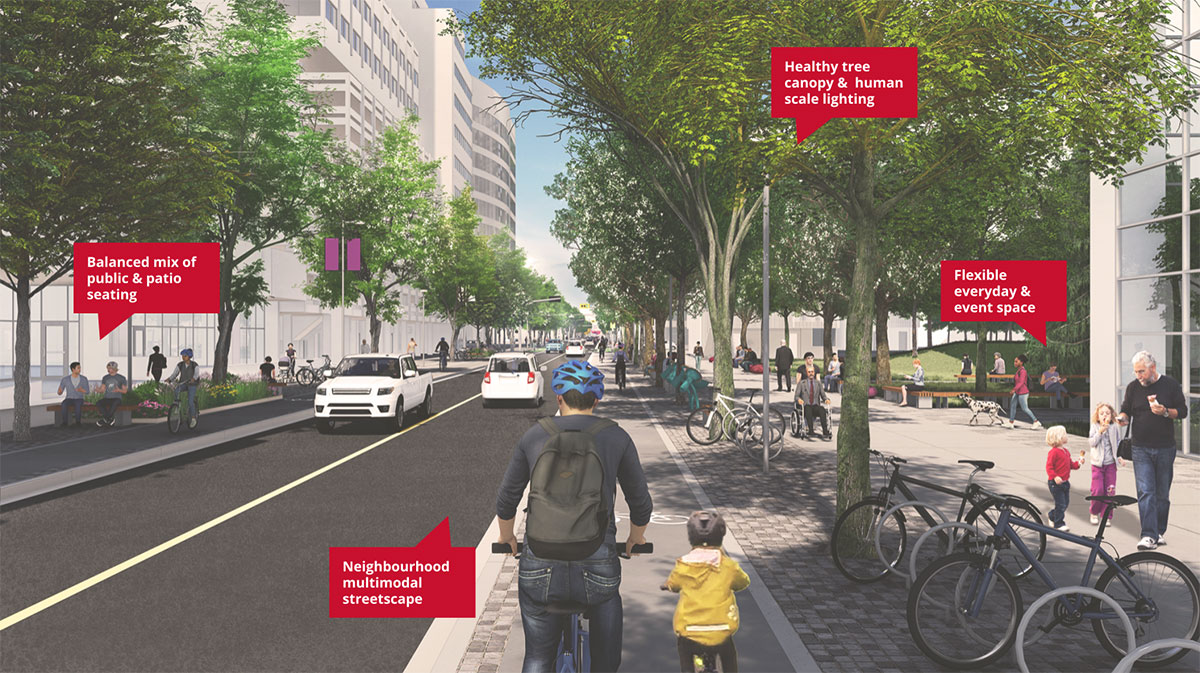
Please note this is a concept design to show general design and uses. Final placement of features and amenities will be determined in the detailed design stage.
Pedestrian priority
Pedestrian priority
As Downtown’s primary pedestrian space, the shared street will be highly walkable and bustling with public life. Pedestrian priority is reinforced across the streetscape, simplifying access and circulation to provide expanded opportunities for programming.
A continuous, dedicated through-zone, distinguished by parallel furnishing zones reinforces pedestrian priority. Across the shared street, there will be no private vehicle access. Emergency access and maintenance vehicles will be accommodated.
Neighbourhood Streetscape
Neighbourhood Streetscape
The multimodal street provides a neighbourhood-scale streetscape where two-way vehicular traffic is complemented by a people-focused public realm. Consistent, unobstructed sidewalks are provided on each side of the street, separated from bike/wheeling lane by furnishing zone.
A continuous, 1.8 meter wide elevated bike and wheeling lane lines the multimodal street, providing dedicated, buffered wheeling space for people on bikes and scooters.
Tree Canopy & Lighting
Tree Canopy & Lighting
Visual and Seasonal Interest with Greenery
Trees along these blocks will provide special moments of visual interest with ornamental features, with flowering and fall foliage, to be discovered.
Street greening, with low planting beds complementing the mix of large trees, further enhances the seasonality, giving character to the streetscape, improves stormwater runoff and promotes biodiversity.
A tree canopy can provide a wide range of benefits including shade, beautification and reductions in urban heat and stormwater runoff. I will also act as a continuous vertical design and identity element for the Avenue.
Lighting
Lighting across all blocks, via pedestrian fixtures, hanging pendents and building accents, will enhance the feeling of safety and extend the Avenue’s programmatic and commercial viability.
Mixed Seating
Mixed Seating
Similar to the shared street, there is equal part commercial and public programming on the multimodal street. Patio seating is the primary commercial offering — as it complements adjacent dining outposts by providing cafe-style seating within the furnishing zone. Patio seating is situated between elements such as trees and light posts which offer a variety of light/shade conditions.
Commercial offerings are complemented by co-located public, free-to-all invites that support the neighbourhood-scale and draw of the street. These offerings include public bench and communal-style seating and play features.
Flexible Spaces
Flexible Spaces
Everyday Activation
Everyday amenities are integrated into the furnishing zone across all blocks. They offer small moments of support for people moving along the sidewalk and include everything from lighting to active mobility parking, waste bins, and benches to stop and rest or socialize.
Special Events
Within the multimodal street, the vehicular lanes within one or more blocks can serve as space for special events, such as block parties or a Christmas Village, through temporary street closures. If the event spans multiple blocks, cross-street traffic may need to be accommodated.
Curbside Management
Curbside Management
Raised intersections in the shared street
Raised intersections are proposed for all shared street blocks. These intersections are designed with subtle transitions to create level centre crossings that ensure a continuous and accessible pedestrian experience. These intersections also allow for vehicles, including transit and delivery uses, to cross due to the subtle grade change.
A consistent approach to accessibility details, such as cane-detectable indicators, bollards, and level paving, makes the intersections navigable for users of all abilities.
Plus 15 Network
Plus 15 Network
Plus 15 Walkway Access at Western Canadian Place
Improved wayfinding, coupled with streamlined circulation along the sidewalk, will draw attention to the existing Plus 15 Walkway connection and make it easier to access.
The use of color can further boost the visibility to the Plus 15 Walkway, making it easier to spot from greater distances.
Raised Intersections
Raised Intersections
Standard Intersections
Intersections are designed to streamline movement for all while reducing conflict between modes. Bump-outs shorten crossing distances and reinforce pedestrian priority.
Bike markings run parallel to crosswalks where wheeling lanes are provided to further reinforce modal hierarchy. Wayfinding inset within paving is aligned with crosswalks to promote intuitive travel between the Avenue and perpendicular streets.
Intersection with Bike Infrastructure Connection
For intersections with perpendicular bike infrastructure, bike markings run parallel crosswalks in each direction, aligned with their respective bike lane. Bike boxes are proposed past the cross-street crosswalks to ensure cyclist safety and reduce potential conflict. Similar bike infrastructure connections occur at intersections on 11 Street S.W., 8th S.W., 7th Street S.W., and 5th Street S.W.
Transition street
4 Street S.W. to 5 Street S.W.
The transition street is where East and West meet, with a clearly marked transition from multimodal circulation to pedestrian-priority.
Trees vertically mark this transition and slows down speeds. Mid-block, vehicle access transitions from two-way to one-way, guiding traffic off the Avenue before meeting the shared street.
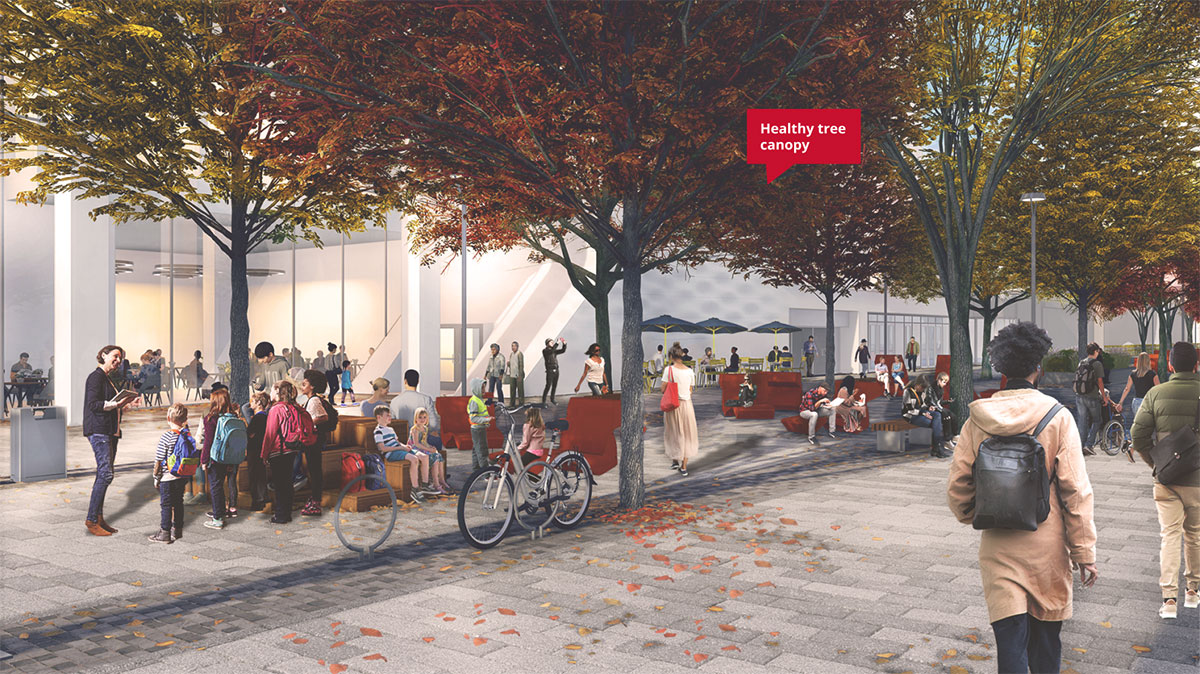
Please note this is a concept design to show general design and uses. Final placement of features and amenities will be determined in the detailed design stage.
[Placeholder]
Pedestrian priority
Pedestrian priority
As Downtown’s primary pedestrian space, the shared street will be highly walkable and bustling with public life. Pedestrian priority is reinforced across the streetscape, simplifying access and circulation to provide expanded opportunities for programming.
A continuous, dedicated through-zone, distinguished by parallel furnishing zones reinforces pedestrian priority. Across the shared street, there will be no private vehicle access. Emergency access and maintenance vehicles will be accommodated.
Tree Canopy & Lighting
Tree Canopy & Lighting
Visual and Seasonal Interest with Greenery
Trees along these blocks will provide special moments of visual interest with ornamental features, with flowering and fall foliage, to be discovered.
Street greening, with low planting beds complementing the mix of large trees, further enhances the seasonality, giving character to the streetscape, improves stormwater runoff and promotes biodiversity.
A tree canopy can provide a wide range of benefits including shade, beautification and reductions in urban heat and stormwater runoff. I will also act as a continuous vertical design and identity element for the Avenue.
Lighting
Lighting across all blocks, via pedestrian fixtures, hanging pendents and building accents, will enhance the feeling of safety and extend the Avenue’s programmatic and commercial viability.
Mixed Seating
Mixed Seating
Similar to the shared street, there is equal part commercial and public programming on the multimodal street. Patio seating is the primary commercial offering — as it complements adjacent dining outposts by providing cafe-style seating within the furnishing zone. Patio seating is situated between elements such as trees and light posts which offer a variety of light/shade conditions.
Commercial offerings are complemented by co-located public, free-to-all invites that support the neighbourhood-scale and draw of the street. These offerings include public bench and communal-style seating and play features.
Flexible Spaces
Flexible Spaces
Everyday Activation
Everyday amenities are integrated into the furnishing zone across all blocks. They offer small moments of support for people moving along the sidewalk and include everything from lighting to active mobility parking, waste bins, and benches to stop and rest or socialize.
Special Events
Within the multimodal street, the vehicular lanes within one or more blocks can serve as space for special events, such as block parties or a Christmas Village, through temporary street closures. If the event spans multiple blocks, cross-street traffic may need to be accommodated.
Curbside use
Curbside use
Raised intersections in the shared street
Raised intersections are proposed for all shared street blocks. These intersections are designed with subtle transitions to create level centre crossings that ensure a continuous and accessible pedestrian experience. These intersections also allow for vehicles, including transit and delivery uses, to cross due to the subtle grade change.
A consistent approach to accessibility details, such as cane-detectable indicators, bollards, and level paving, makes the intersections navigable for users of all abilities.
Plus 15 Network
Plus 15 Network
Plus 15 Walkway Access at Western Canadian Place
Improved wayfinding, coupled with streamlined circulation along the sidewalk, will draw attention to the existing Plus 15 Walkway connection and make it easier to access.
The use of color can further boost the visibility to the Plus 15 Walkway, making it easier to spot from greater distances.
Raised Intersections
Raised Intersections
Standard Intersections
Intersections are designed to streamline movement for all while reducing conflict between modes. Bump-outs shorten crossing distances and reinforce pedestrian priority.
Bike markings run parallel to crosswalks where wheeling lanes are provided to further reinforce modal hierarchy. Wayfinding inset within paving is aligned with crosswalks to promote intuitive travel between the Avenue and perpendicular streets.
Intersection with Bike Infrastructure Connection
For intersections with perpendicular bike infrastructure, bike markings run parallel crosswalks in each direction, aligned with their respective bike lane. Bike boxes are proposed past the cross-street crosswalks to ensure cyclist safety and reduce potential conflict. Similar bike infrastructure connections occur at intersections on 11 Street S.W., 8th S.W., 7th Street S.W., and 5th Street S.W.
Full Streetscape Master Plan
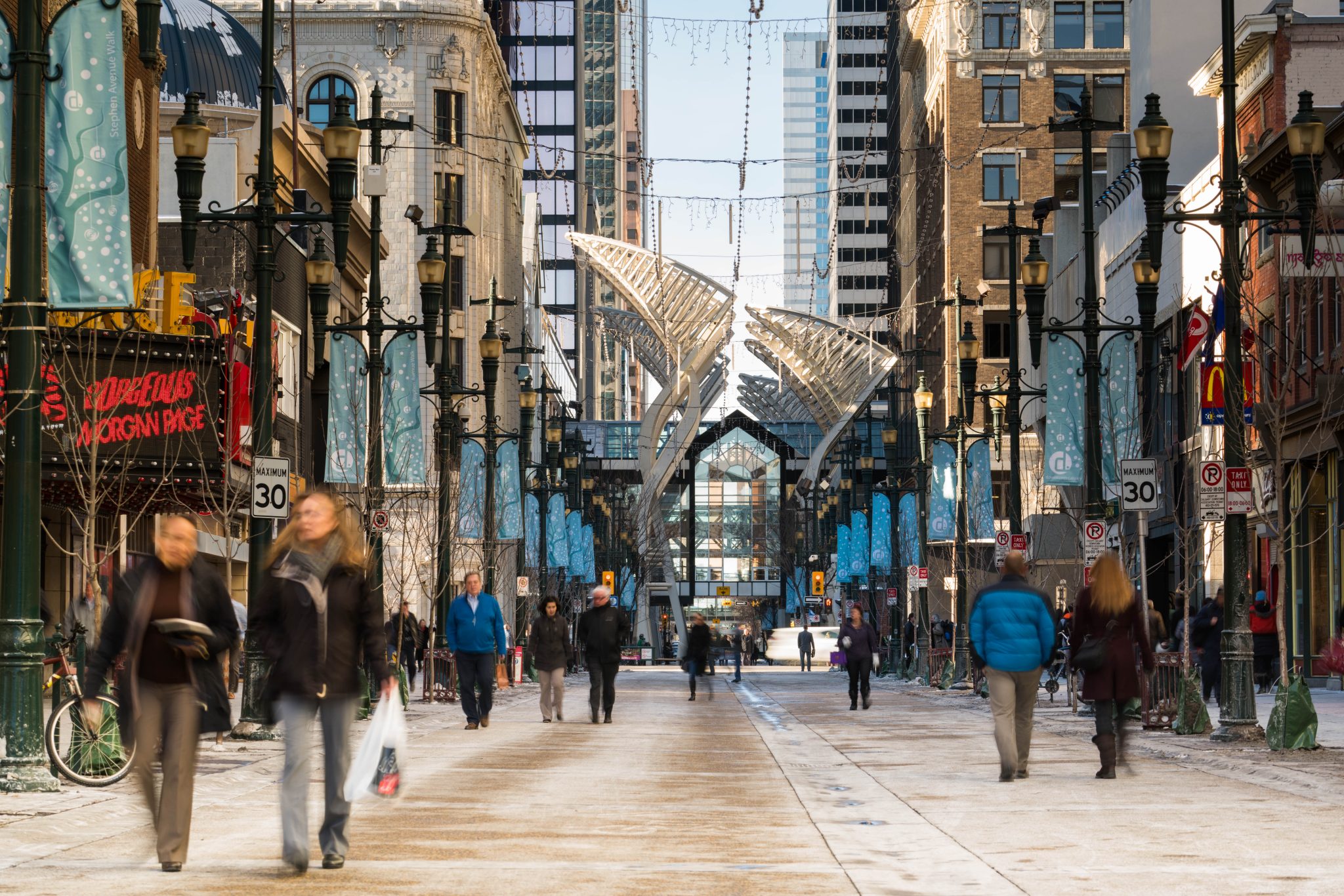
More than ever. Like never before. Stephen Avenue
The City is investing in the future and transforming, modernizing and reinventing Stephen Avenue.
We are on an exciting journey to reimagine Stephen Avenue and position it for a renewed era of success. As a flagship project for Calgary’s Downtown Strategy, The Stephen Avenue project provides a foundation for The City to collaborate with Calgarians to consider and implement strategic improvements – whether near, medium or longer term – that will re-position Stephen Avenue, and ensure its future as Calgary’s hallmark downtown main street.
To learn more about the project and completed engagement, visit engage.calgary.ca/stephenavenue
Timeline
Where we are now – Phase 2
In the current phase of the project, The City is developing a Streetscape Master Plan that will shape how Stephen Avenue looks, feels and is experienced by Calgarians and visitors.
Developing a robust Streetscape Master Plan is key to bringing the vision for Stephen Avenue to life and will serve as a guiding document as the project moves into detailed design and construction. The Streetscape Master Plan is informed by the vision set in Phase 1, public feedback, and technical engineering studies to ensure that the design is implementable.
The Streetscape Master Plan provides a design for a vibrant, high quality street that is a connector of people and places and a downtown destination in its own right. The design aims to improve mobility, connectivity, accessibility, safety and beautify the Avenue. It also places priority on placemaking and sociability, where Calgarians from all walks of life are excited to visit more often and stay longer.
In February 2023, we hosted engagement where we shared draft ideas for the Streetscape Master Plan. We asked for your feedback on draft representative cross-section designs, key design moves, and desired programming on the Avenue. The What we Heard Report can be viewed here. Our team is now working on the finalizing the Streetscape Master Plan. The final Master Plan will be revealed in late Summer of 2023.
Previous work: Public Realm Action Plan
From 2019 through 2020, the Stephen Avenue project kicked off its first phase with a public realm study that provided a vision and roadmap for the future success of Stephen Avenue. Throughout the public realm study process, citizens and partners were engaged to understand challenges and opportunities for Stephen Avenue and define what success looks like. The insights from engagement were fundamental in the development of the Future of Stephen Avenue Phase 1: Public Realm Action Plan.
In Phase 1 of the project, a vision for the Future of Stephen Avenue was created:
Stephen Avenue is Calgary’s main connector to arts, culture and commerce and offers a stage for experimentation and innovation.
A 21st century street, Stephen Avenue links Calgary’s walkable urban core to its neighbourhoods through a great public realm. Active day and night, and throughout the year, Stephen Avenue is a catalyst for a resilient economy, enabling adaptation towards Calgary’s future. As Calgary’s premier local and tourist destination, Stephen Avenue fosters social interaction, civic gathering, and community pride.
Please read the Public Realm Action Plan to learn more about Phase 1 of the project, public engagement and how this vision was established.
Construction Implementation
Stephen Avenue plays an important role in the success of Downtown Calgary. The implementation plan and proposed construction phasing considers the impacts and relationships to adjacent projects, including those in-progress and planned for future.
A construction phasing plan has been developed that divides that Avenue into three manageable work areas.
Detailed design and construction of these work areas will proceed at varied paces. The implementation and phasing plan will continue to evolve as new information becomes available.
-
Work Area A
This work area will proceed to align with key projects such as the Revitalize 8th St SW project and office to residential conversion projects. Implementation of this area will serve as a critical connection to Downtown West.
-
Work Area B
Aligned with the Glenbow Renovation opening and nearby projects such as 1 ST SE, implementation of this area will serve as a catalyst for the east portion of the Avenue.
-
Work Area C
Implementation of Area C will tie the Shared and Multi-Modal street types together.
* Note: The design of the 200 block will be confirmed in coordination with Werklund Centre & Olympic Plaza and will be delivered by CMLC.