

Asian Heritage Month

Asian Heritage Month
The mayor proclaimed May as Asian Heritage Month in Calgary, acknowledging the role Asian communities play in enriching our cultural diversity and vibrancy. With roots spanning across East Asia, Southern Asia, Western Asia, Central Asia, and Southeast Asia, these communities contribute immensely to the city's dynamic cultural tapestry.
We are dedicated to fostering a deeper understanding and appreciation of the rich heritage and contributions of Asian communities. Through various programs, partnerships and community‑led initiatives, The City actively engages with these communities to promote inclusivity and celebrate their invaluable impact on Calgary.
Why is recognizing Asian Heritage Month important?
Asian Heritage Month has been officially recognized in Canada since 2002. This month‑long observance honours the rich cultural heritage brought by people from all parts of Asia over the past two centuries and recognizes the lasting contributions Asian Canadians have made to our country.
Asian communities have shaped many aspects of Canadian life, including the arts, sciences, sports, business, and public service. In the 2021 Census, just over 7 million people in Canada reported full or partial Asian ethnicity, representing approximately 19-20% of the population. Asian Canadians are:
- The largest visible minority population in Canada
- One of the fastest‑growing population groups nationwide
While Asian Heritage Month is a time to celebrate accomplishments and contributions, it is also important to acknowledge the rise in racism and discrimination experienced by Asian Canadians in recent years. Recognizing this reality reinforces the need for continued learning, allyship, and action.
The City of Calgary is committed to actively dismantling systemic racism that affects the lives of Indigenous, Black and diverse Racialized Peoples. Visit Calgary's Commitment to Anti-Racism for more information.
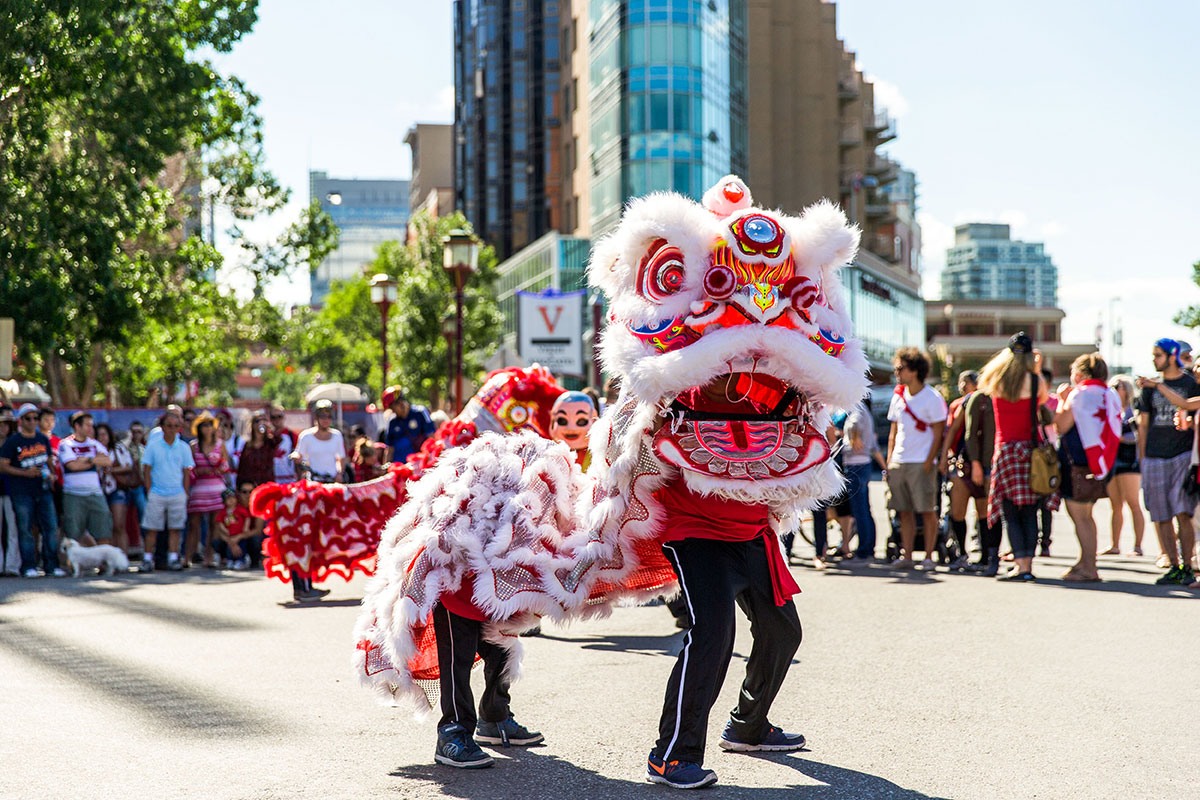
Community funding
Chinatown Activation Microgrant supports initiatives in Chinatown that energize the community and celebrate its heritage through cultural activity, from learning, experiences and celebrations. With up to $3,000 available per initiative, funding is open to individuals, community groups, businesses, nonprofits and cultural or social organizations. Applications accepted until all funds have been awarded.
Learn more about the Chinatown Activation Microgrant and discover upcoming events in Chinatown by the fund.
Click to learn moreResources
Learn
Learn
Books
- Being Chinese in Canada: The Struggle for Identity, Redress and Belonging by William Ging Wee Dere
- Chop Suey Nation: The Legion Café and Other Stories by Ann Hui (2019)
- Changing on the Fly: Hockey through the voices of South
- Running on Empty: Canada and the Indochinese Refugees, 1975-1980 by Michael J. Molloy, Peter Duschinsky, Kurt F. Jensen and Robert Shalka
- The light of Eternal Sprig by Angel Di Zang
- Here After by Amy Lin
- This Red Line Goes Straight to Your Heart by Madhur Anand
- Children’s Books
- Asian Heritage Month Booklist by Calgary Public Library
- Found: Tales of Chinese Canadian Settlers written and illustrated by Junyi Bu and Jane Xu
- The Doll by Nhung N. Tran-Davies (Article)
Multimedia
On National film board of Canada (NFB)
Becoming Labrador
In the stark Labrador interior, a growing number of Filipino workers have recently landed in Happy Valley-Goose Bay, travelling halfway around the world for jobs they hope will offer their families new opportunities and a better life. Becoming Labrador follows a handful of those women and men as they make a place for themselves in Labrador while dealing with the unexpected costs of living far from their family.
The Chinese-Canadian Experience (Ages 15-17)
A playlist of different films that explore the Chinese-Canadian experience. Chinese-Canadians, have had to navigate various levels of politicized racism, emotional turmoil and financial hardship in their adopted country. What emerges from each of these films and the stories they tell is the dignity, good humour and resourcefulness of their subjects.
Sleeping Tigers: The Asahi Baseball Story by Jari Osborne
This feature-length documentary tells the story of the Asahi baseball team. In pre-World War II Vancouver, the team was unbeatable, winning the Pacific Northwest Championship for five straight years. After the Japanese attack on Pearl Harbor, all persons of Japanese descent in Canada were sent to internment camps. The former Asahi members survived by playing ball. Their passion was contagious and soon other players joined in, among them RCMP officials and local townspeople. As a result, the games helped break down racial and cultural barriers.
Between: Living in the Hyphen
Anne Marie Nakagawa's documentary examines what it means to have a background of mixed ancestries that cannot be easily categorized. By focusing on 7 Canadians who have one parent from a European background and one of a visible minority, she attempts to get at the root of what it means to be multi-ethnic in a world that wants each person to fit into a single category.
A Passage Beyond Fortune
Through an intimate archive of the Chow’s family lineage, A Passage Beyond Fortune offers an homage to the culturally significant but buried history of Chinese-Canadian communities in Moose Jaw.
Ru
Based on the Governor General's Award-winning novel by Kim Thúy, Ru is the story of the arduous journey of a wealthy family fleeing from Vietnam, before landing in Quebec. Learn more about Ru.
Boat People - National Film Board (NFB)
Flowing Home - National Film Board (NFB)
YouTube
Celebrate Canada's Asian Heritage - Asian Heritage Month
Heritage Minutes: "Boat People" Refugees
Japanese-Canadian Internment
Heritage Minutes: Norman Kwong
Remembering the journey to Canada of Vietnamese refugees - Asian Heritage Month
I hid my Afghan identity for years
Reflect
Reflect
- Asia is not a monolith. What new perspectives did you learn this month about the diversity within Asian communities (e.g., cultures, languages, migration histories)?
- What surprised you most about the history or contributions of Asian communities in Calgary or Canada?
- How does learning about Asian histories challenge or expand what you were previously taught or assumed?
- What connections do you see between historical discrimination and present-day experiences of anti-Asian racism?
- Where do you notice silence, invisibility, or stereotypes affecting Asian voices in workplaces or institution?
- How can you better create space for Asian voices, leadership, and lived experience?
- What is one concrete action you can take to challenge anti-Asian racism in your role, team, or community?
Act
Act
Events
The City of Calgary provides microgrants to local community groups and non-profits for events and initiatives that celebrate arts and culture. Explore microgrant events happening during Asian Heritage Month:
FacinAsian 2026: Asian Heritage Month Kickoff:
The FacinAsian Festival's mission is to celebrate and promote Asian perspectives, culture and integrity in film and media.
- Date: Calgary April 30-May 3
- FascinAsian Film Festival
Asian Heritage Foundation Featured Events: Asian Heritage Month 2026 - Asian Heritage Foundation
Chinatown Activation Microgrant Events: Chinatown Activation Microgrant
Other funding programs available: Supporting Anti-Racism in the community
Explore more
Explore more
Commemorating the end of the Vietnam War
2025 marks the 50th anniversary of the end of the Vietnam War, a pivotal event that led to approximately 60,000 Vietnamese refugees finding new homes and opportunities in Canada. The Journey to Freedom Park honours the thousands of Vietnamese refugees who fled after the fall of Saigon in 1975 and arrived in Canada. The vast majority of Vietnamese refugees, including children, fled the country by boat, many lost their lives as they fled for freedom.

Culture in Chinatown
Calgary’s Chinatown is a unique neighbourhood with a meaningful culture for its residents and all Calgarians.
The Chinatown Program is an ongoing effort to bring the community’s vision for Chinatown to life, keeping it a vibrant, culturally rich place to live, work and visit. It’s part of Tomorrow’s Chinatown, an initiative that includes the Chinatown Cultural Plan - a community-driven plan for celebrating and investing in Chinatown’s cultural future. The Chinatown Program turns this plan into action by supporting projects, programs and partnerships that honour Chinatown’s heritage while helping it grow.

The History of Asian People in Calgary
Asian Canadians have been integral to Canada's social, political, and economic landscape for over 200 years. In Alberta, particularly Calgary, the earliest arrivals of Asian descent were people of Chinese, Japanese and Sikh heritage. These pioneers established communities and legacies that future immigrants from various Asian countries have joined, benefitted from and continue to build upon.
Please note: The communities referenced below represent only a small selection of the rich and diverse Asian diaspora.
Chinese Canadians
The Asian presence in Calgary dates back to 1883, with the arrival of Chinese residents from British Columbia who had worked on the newly completed Canadian Pacific Railway. Unable to return to China after the Canadian Government withdrew its promise to pay their return fare home, 50 residents established the first Chinatown on the east side of 8th Avenue. From its founding in 1885, Chinatown has been in three different locations in Calgary. Displacement and racial discrimination forced the community to move as they struggled to set down roots. Calgary has the dubious distinction of being home to one of Alberta’s worst episodes of anti-Chinese hostility, the 1892 Smallpox Riot.
Hull's Terrace (including Home Confectionery)

Japanese Canadians
Japanese Canadians began migrating from British Columbia to Alberta in the early 1900s as labourers in industries such as mining, railway construction and sugar beet farming. Due to racial discrimination, many were prohibited from living in cities and instead settled in Raymond, Alberta, about 30 minutes south of Lethbridge. In 1922, the first Japanese store in Alberta was opened by two Japanese people at 119 - 8 Ave SW, Calgary.
Sources

The Calgary Milling Company in 1924, when it was known as John Irwin and Company. It would be leased by Nippon Silk and Products Co. starting in 1931.
Image: "8th Avenue SW, Calgary, Alberta" [ca. 1924]. (CU1105766) by Oliver, W.J.. Courtesy of Glenbow Library and Archives Collection, Liberties and Cultural Resources Digital Collections, University of Calgary.
Sikh Canadians
The history of Sikhs in Calgary dates back to 1908, with their presence in the province dating back to 1903 when Sikhs began migrating to Crowsnest Pass. Early Sikhs worked as miners, lumber workers, and farmers. While much is still being uncovered about Sikh history in Alberta and Calgary through the Southern Alberta Sikh Project, it is remarkable to note that members of one Sikh Calgarian family have become sixth-generation Calgarians, highlighting the ways Sikhs have helped build Alberta.
Sources

"Harnan Singh Hari, driving wagon, DeWinton area, Alberta", 1913, (CU1102785) by Unknown.
Courtesy of Glenbow Library and Archives Collection, Libraries and Cultural Resources Digital Collections, University of Calgary.
Asian Calgarians today
These early communities of Asian Calgarians and Albertans faced harsh racial discrimination, including immigration restrictions. It wasn’t until 1967, when immigration restrictions based on race and country of origin were eliminated, that significant populations of immigrants from various Asian countries were able to establish communities in Canada and Calgary.
Throughout over 200 years of Asian immigration and refugee settlement in Canada, Asian Canadians have continually enriched the country's vibrance.
Asian Heritage Month is part of Calgary’s broader commitment to celebrating diverse cultures and supporting a thriving arts community. Explore these resources to learn more about how The City fosters creativity and cultural connection year-round:
- Arts and Culture in Calgary – Discover how Calgary supports and celebrates the arts through public art, events and cultural programs.
- Cultural Plan for Calgary – This 10-year action plan guides the city’s approach to arts, heritage and cultural resources, ensuring a thriving and inclusive cultural landscape.
- Calgary’s Culture Days – Culture Days takes place every September 1 – 30 and is a celebration of arts, culture, heritage, diversity and community spirit.
