

26 Avenue S.W. improvements
Project overview
26 Avenue S.W. is an important east-west route that many Calgarians rely on to get to school, work, transit, parks, and local businesses. As traffic along the corridor has increased and travel needs have changed, updates are needed to help everyone get where they’re going safely.
This project will make travel along 26 Ave S.W. between 37 St. and 14 St. S.W. safer, more comfortable, and more reliable for everyone – whether they walk, bike, ride, or drive.
Key improvements include:
- Protected bike lanes and multi‑use pathways
- Upgraded intersections
- New floating bus stops
- A reduced speed limit of 40 km/h
- Improved street lighting
To minimize future disruption to the community and make better use of resources, the project is coordinating roadway upgrades with other planned City work.
Additional work includes:
- Road repaving and reconstruction
- Crowchild Trail Bridge rehabilitation
- MAX Yellow BRT station upgrades
- Underground water main replacements and storm system improvements
-
Support Local Businesses!
Businesses along 26 Avenue S.W. remain open during construction – stop by, support local, and show them some love!

Project update – October 2026
Construction along the corridor is underway.
West of Crowchild Trail
- Road repaving, bike lane medians, streetlight upgrades, transit stop improvements and accessible wheelchair ramp upgrades between 25 Street S.W. and 29 Street S.W. are now complete.
- Mobility upgrades between 29 Street S.W. and 33 Street S.W. are expected to begin in mid-October and continue into early November.
- A sanitary trunk upgrade between 31 Street S.W. and 32 Street S.W. will take place at the same time as the mobility upgrades.
East of Crowchild Trail
- The water main replacement between 14 Street S.W. and 15 Street S.W. and water main replacement and storm system upgrades between 16 Street S.W. and 18 Street S.W. are now complete.
- Mobility upgrades between 14 Street S.W. and 16 Street S.W. are expected to begin in early October and continue into November. This work includes road reconstruction and repaving, multi-use pathway installation, street lighting upgrades, transit stop improvements, curb extensions and accessible wheelchair ramp upgrades.
See the Construction section below for more details on the construction schedule.
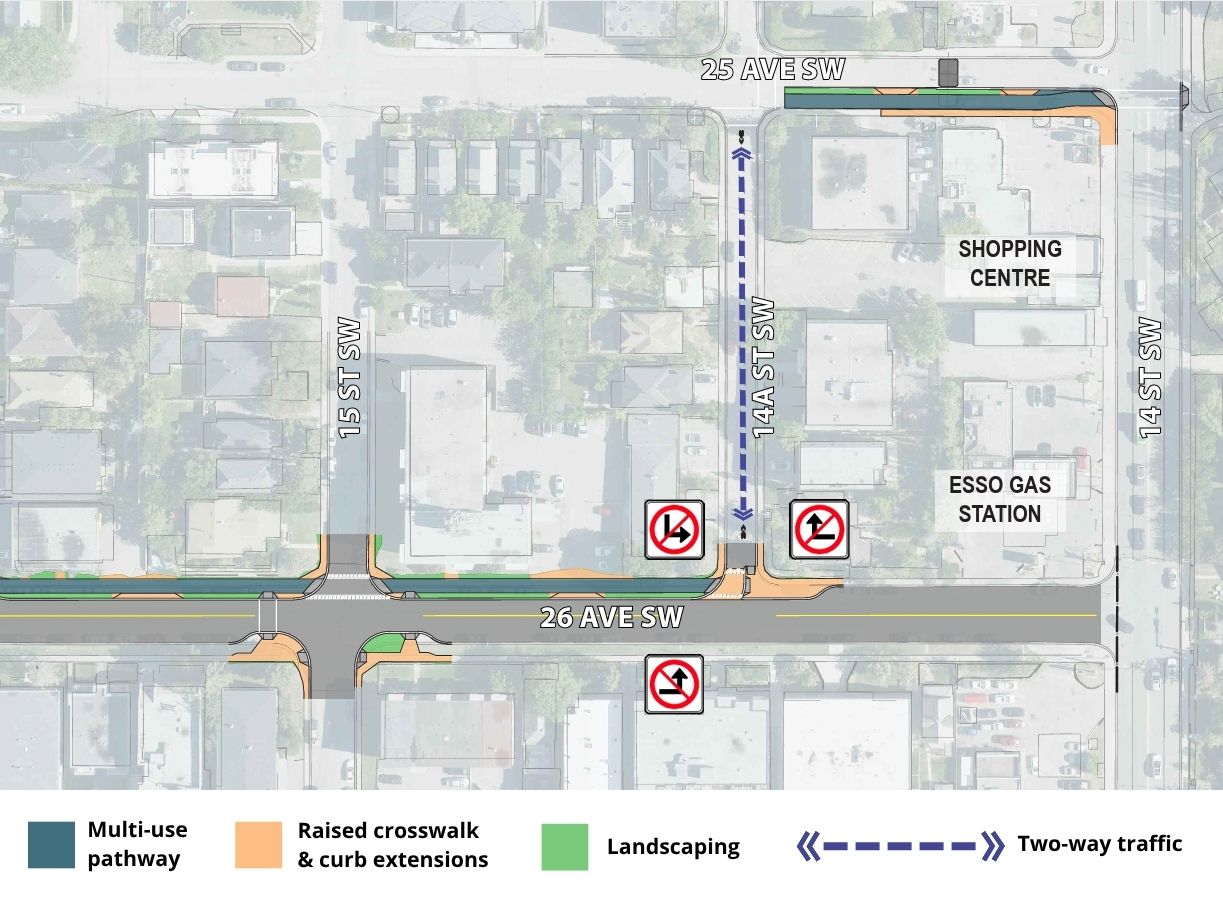
Upcoming changes to vehicle access on 14A Street S.W.
The intersection of 26 Avenue S.W. and 14A Street S.W. is being redesigned to improve safety and accessibility for people walking, wheeling, cycling and driving.
To support these improvements, vehicle access at the intersection will change beginning in November 2026, following completion of the mobility upgrades between 14 Street S.W. and 16 Street S.W.
- Vehicles will no longer be able to enter 14A Street S.W. from 26 Avenue S.W.
- Vehicles exiting 14A Street S.W. will only be able to turn right onto westbound 26 Avenue S.W. Left turns from 14A Street S.W. onto eastbound 26 Avenue S.W. will no longer be permitted.
Project timeline
Project design
Construction
Construction began in August 2026 and is expected to continue into 2028. Work is being completed in phases, so crews will be in front of individual properties for a short time, not for the full duration of the project.
The following construction schedule provides a high-level overview of when and where work is expected to occur. More detailed schedules and construction notices will be shared with affected residents, businesses and property owners before work begins in each area.
Please note: Timelines may shift due to factors such as weather, supply chain delays, or unexpected site conditions.
West segment
West segment
25 St. S.W. to 38 St. S.W.
Mobility upgrades
Work includes:
- Road repaving
- Bike lane medians
- Street lighting upgrades
- Transit stop improvements
- Accessible wheelchair ramp upgrades
Mobility upgrades: West segment (25 St. S.W. to 38 St. S.W.)

| Phase / Location | Timing | Traffic and access impacts |
|---|---|---|
|
Phase / Location
:
Phase 1: 25 St. S.W. to 26 St. S.W. |
Timing
:
Complete: Work wrapped up in September 2026. |
Traffic and access impacts
:
|
|
Phase / Location
:
Phase 2: 26 St. S.W. to 29 St. S.W. |
Timing
:
Complete: Work wrapped up in early October 2026. |
Traffic and access impacts
:
|
|
Phase / Location
:
Phase 3: 29 St. S.W. to 33 St. S.W. |
Timing
:
Scheduled: Expected to start the week of October 13 and be complete early November. |
Traffic and access impacts
:
|
|
Phase / Location
:
Phase 4: 33 St. S.W. to 37 St. S.W. |
Timing
:
Scheduled: Spring 2027 |
Traffic and access impacts
:
|
|
Phase / Location
:
Phase 5: 37 St. to 38 St. S.W. |
Timing
:
Scheduled: Spring 2027 |
Traffic and access impacts
:
|
Crews may return later to complete landscaping, site restoration and other minor finishing work.
East segment
East segment
14 St. S.W. to 22 St. S.W.
Underground utility upgrades (14 Street S.W. to 18 Street S.W.)
Work includes:
- Water main replacements
- Stormwater system upgrades
Underground utility upgrades: 14 Street S.W. to 18 Street S.W.

| Phase / Location | Anticipated timing | Traffic and access impacts |
|---|---|---|
|
Phase / Location
:
Phase 1: 18 St. S.W. to 17 St. S.W. |
Anticipated timing
:
Complete: Work completed in September 2026. |
Traffic and access impacts
:
|
|
Phase / Location
:
Phase 2: 17A St. S.W. to 16 St. S.W. |
Anticipated timing
:
Complete: Work completed in September 2026. |
Traffic and access impacts
:
|
|
Phase / Location
:
Phase 3: 14 St. to 15 St. S.W. |
Anticipated timing
:
Complete: Work completed in October 2026. |
Traffic and access impacts
:
|
Crews may return later to complete landscaping, site restoration and other minor finishing work.
Mobility upgrades (14 Street S.W. to 22 Street S.W.)
Work includes:
- Road reconstruction and repaving
- Multi-use pathway installation
- Street lighting upgrades
- Transit stop improvements
- Curb extensions and accessible wheelchair ramp installation
Mobility upgrades: 14 Street S.W. to 22 Street S.W.

| Phase / Location | Anticipated timing | Traffic and access impacts |
|---|---|---|
|
Phase / Location
:
Phase 1: 14 St. S.W. to 16 St. S.W. |
Anticipated timing
:
In progress: Construction began in early October and is expected to be complete in November 2026. |
Traffic and access impacts
:
|
|
Phase / Location
:
Phase 2: 16 St. S.W. to 18 St. S.W. |
Anticipated timing
:
Scheduled: Spring 2027 |
Traffic and access impacts
:
|
|
Phase / Location
:
Phase 3: 18 St. S.W. to 20 St. S.W. |
Anticipated timing
:
Scheduled: Spring 2027 |
Traffic and access impacts
:
|
|
Phase / Location
:
Phase 4: 20 St. S.W. to 22 St. S.W. |
Anticipated timing
:
Scheduled: Summer 2027 |
Traffic and access impacts
:
|
|
Phase / Location
:
Phase 5: 25 Ave. S.W. |
Anticipated timing
:
Scheduled: Summer 2027 |
Traffic and access impacts
:
|
Crews may return later to complete landscaping, site restoration and other minor finishing work.
Crowchild Trail Bridge
Crowchild Trail Bridge
22 St. S.W. to 25 St. S.W.
Bridge and mobility upgrades
Work includes:
- Bridge rehabilitation
- Bridge deck resurfacing
- Multi-use pathways
- Street lighting upgrades
- Transit stop improvements
Mobility upgrades and bridge rehabilitation: Crowchild Trail Bridge segment (22 St. S.W. to 25 St. S.W.)

| Phase / Location | Anticipated timing | Traffic and access impacts |
|---|---|---|
|
Phase / Location
:
Phase 1: 22 St. S.W. to 25 St. S.W. |
Anticipated timing
:
Scheduled: Summer/Fall 2027 |
Traffic and access impacts
:
|
|
Phase / Location
:
Phase 2: 26 Ave. S.W. MAX Yellow BRT Station Upgrades |
Anticipated timing
:
Scheduled: Summer/Fall 2027 |
Traffic and access impacts
:
|
Crews may return later to complete landscaping, site restoration and other minor finishing work.
Outreach and engagement
Public engagement in 2021 and 2023 helped us understand how people use 26 Avenue S.W. and identify local priorities, concerns, and opportunities. Feedback from these sessions helped inform the project as it moved forward. Visit the engage page for more information.
Engagement summaries
In November 2025, we shared updated design details and answered questions at a community information session.
Budget and funding
Budget
City Council has approved a total budget of $21.7 million to deliver this project.
Funding
The project is funded through a combination of City programs and operational budgets, including:
- $5.7M from the Established Area Growth and Change Strategy (EAGCS) program
- $7.5M from the Housing Accelerator Fund (HAF)
- $8.5M from operational budgets
Frequently asked questions (FAQs)
Project overview
Why are improvements to 26 Avenue S.W. needed?
26 Avenue S.W. is a key east-west route in southwest Calgary. It runs through eight communities and connects people to nearby schools, work, transit, parks, and more than 50 local businesses. It is also the only east-west crossing of Crowchild Trail in this area, making it an essential link for everyday travel.
Today, the corridor serves more people, more destinations, and more ways of travelling than it was originally designed for. In some areas, people walking, biking, riding and driving share limited space, which can create safety challenges and make travel feel uncomfortable.
Community feedback and recent serious incidents have reinforced the need to address these issues.
Improvements to the corridor will help address these issues by focusing on:
- Reducing conflicts between different road users
- Improving visibility at intersections
- Supporting lower vehicle speeds
These changes aim to help lower the risk of serious collisions and make travel along the corridor feel more comfortable and predictable.
Whether it’s a walk to the park, a bike ride to school, a bus trip to the store, or a drive home, this project will help ensure Calgarians travelling along 26 Avenue S.W. arrive safely, today and as nearby communities continue to grow.
What work is happening as part of the mobility and safety upgrades?
Work includes:
Protected bike lanes and multi-use pathways
The new design will improve current conditions by:
- Replacing painted bike lanes between 37 Street S.W. and 22 Street S.W. with protected bike lanes that are physically separated from traffic.
- Adding multi-use pathways between 22 Street S.W. and 14 Street S.W., where people currently share the road with vehicles.
These upgrades will create a safer, more comfortable space for people biking and wheeling along the entire route.
Upgraded intersections
Curb extensions will be added to the south side intersections between 22 Street S.W. and 15 Street S.W., as well as the east corner on 14A Street S.W. Wheelchair ramps at these intersections will also be upgraded with tactile strips. These changes will improve visibility at intersections and make it safer and easier for people to cross the street.
Lower speed limit
The speed limit will be reduced from 50 km/h to 40 km/h between 14 Street S.W. and 37 Street S.W. Lower speeds help reduce the risk and severity of collisions.
Improved street lighting
Street lighting will be upgraded between 16 Street S.W. and 23 Street S.W. to improve visibility.
Why is additional City work being completed as part of the project?
In addition to mobility and safety improvements, the project includes other planned City work such as water utility upgrades, road repaving, and bridge rehabilitation.
Coordinating this work into one project helps avoid additional construction projects along the same corridor in the future. This reduces the need to dig up the street again and helps save time, lower overall costs, and limit construction impacts for nearby residents, businesses, and people travelling through the area.
How does the project support travel now and in the future?
As communities along 26 Avenue S.W. continue to grow and redevelop, travel demand along the corridor is increasing and changing. More people are making everyday trips on 26 Avenue S.W., and they are doing so in a wider variety of ways.
This project helps prepare the corridor for future growth by updating the street to support safe, reliable, and well‑connected travel options for people walking, cycling, using mobility devices, taking transit, and driving—both now and as the area continues to grow.
The project is partially funded through The City’s Established Area Growth and Change Strategy (EAGCS), which supports infrastructure improvements in established communities experiencing growth. It also aligns with the Westbrook Communities Local Area Plan, which identifies 26 Avenue S.W. as a key corridor for walking and cycling improvements.
Will the project remove vehicle travel lanes?
No. Vehicle travel lanes will remain the same.
Roadwork and bridge rehabilitation
What roadwork is being completed?
Roadwork along 26 Avenue S.W. includes both repaving and full road reconstruction. This work helps improve the condition, safety, and long‑term durability of the roadway along the corridor.
- Road repaving between 37 Street S.W. and 25 Street S.W.
- Road repaving involves removing and replacing the top layer of asphalt. This smooths the road surface, improves driving comfort, and extends the life of the roadway where the base underneath is still in good condition.
- Road reconstruction between Richmond Road S.W. and 14 Street S.W.
- Road reconstruction involves rebuilding the road structure, including the base beneath the pavement, to address areas with aging infrastructure or long‑term condition issues.
What bridge work is being completed?
Crowchild Trail Bridge rehabilitation work will include structural repairs and surface repaving to help extend the life of the bridge.
New multi‑use pathways will replace the sidewalk on both the north and south sides of the bridge, creating safer and more comfortable connections for people walking, cycling, and accessing transit.
Transit improvements
What transit upgrades are included?
- Floating bus stops between 25 Street and 37 Street S.W.
- Upgrades to MAX Yellow BRT stations at 26 Avenue & Crowchild Trail S.W.
Why are floating bus stops being added?
Floating bus stops are bus stops where the boarding area is located between the bike lane and the vehicle lane, instead of at the curb.
Today, buses on 26 Avenue S.W. must cross into and stop in the bike lane to pick up passengers. With a floating bus stop, buses can stop in the traffic lane without crossing the bike lane. This design reduces conflicts between buses and people biking, and helps make travel safer and more predictable for everyone.
Will any bus stops move?
Some bus stop locations will be adjusted slightly to improve traffic flow along the corridor.
What changes are being made to the 26 Avenue & Crowchild Trail S.W. MAX Yellow BRT stations?
Planned upgrades to both the northbound and southbound 26 Avenue & Crowchild Trail S.W. MAX Yellow BRT stations will bring them up to current BRT Station standards. The project will also add a new transit plaza next to the southbound station to improve comfort, accessibility, and connections for transit customers.
Visit the 26 Avenue S.W. MAX Yellow BRT Station Upgrades project page for more information.
Safety improvements
How will the project make the corridor safer?
The project includes traffic calming measures, upgrades to active travel infrastructure and additional safety improvements that will make 26 Avenue S.W. safer for people walking, biking, riding, driving, and taking transit.
The design follows The City’s 5A guidelines, which focus on making travel safe and accessible year‑round for people of all ages and abilities.
The upgrades support The City’s Vision Zero commitment to eliminate serious injuries and fatalities on our roads.
Key safety improvements include:
Protected bike lanes and multi-use pathways
Currently, people cycling or wheeling along 26 Avenue S.W. travel in painted bike lanes or share lanes with vehicle traffic. By replacing these with protected bike lanes and multi‑use pathways, the project increases physical separation between vehicles and more vulnerable road users, creating safer and more comfortable spaces to travel.
Lower speed limit
The speed limit on 26 Avenue S.W. will be reduced from 50 km/h to 40 km/h. Lower speeds give drivers more time to see and react to people crossing the street or travelling along the corridor and reduce the likelihood and severity of collisions.
Upgraded intersections with curb extensions
Curb extensions shorten crossing distances and improve sightlines between people walking and approaching drivers and cyclists, making intersections safer and easier to navigate.
Floating bus stops
Currently, buses along 26 Avenue S.W. must cross into and stop in the bike lane. Floating bus stops allow buses to stop without crossing the bike lane. This design helps reduce conflicts between buses, people biking or wheeling, and people boarding or leaving the bus.
Will there be new crosswalks?
Yes. New painted crosswalks are planned at select locations. Final locations will be shared once confirmed.
How will emergency vehicles access buildings if there is a protected bike lane?
Emergency response teams are trained to access properties quickly in all situations. The bike lane buffer has been designed to allow emergency vehicles to pass over it safely, if required.
Bike lanes and pathways
Who can use the bike lanes and pathways?
Protected bike lanes are intended for:
- People riding bicycles
- People using other small, wheeled mobility devices, such as e‑bikes and e‑scooters
Multi‑use pathways are shared spaces for:
- People walking or jogging
- People using wheelchairs or other mobility devices
- People cycling or using other small, wheeled mobility devices
All pathway users are encouraged to keep right, be aware of others, and travel at safe speeds.
For more information about where different travel modes are allowed, please refer to The City’s mobility guidelines.
Will there be speed limits on the protected bike lanes and multi use pathway?
People riding in protected bike lanes are expected to follow the posted 40 km/h speed limit.
Those using the multi-use pathway will need to adjust their speed to approximately 20 km/h or less, due to the shared nature of the facility and the presence of people walking.
More information about bylaws on pathways and safety tips can be found here.
Parking
How will on-street parking be affected?
We know on‑street parking is important to residents, visitors, and local businesses. That’s why the project team worked carefully to keep as much parking as possible while improving safety along the corridor.
At the same time, 26 Avenue S.W. is a busy street with limited physical space and there isn’t enough room to safely accommodate on‑street parking, moving traffic, and the planned safety improvements.
To implement safety improvements along the corridor, on‑street parking will be removed in the following locations:
- South side of 26 Avenue S.W. west of Crowchild Trail (37 Street S.W. to 25 Street S.W.)
- North side of 26 Avenue S.W. east of Crowchild Trail (22 Street S.W. to 14A Street S.W.)
Why are parking changes needed?
In some locations along 26 Avenue S.W., the street is not wide enough to accommodate safety improvements and keep all on‑street parking. Adjustments to on‑street parking in these areas make it possible to reduce conflicts between people using different modes of transportation and improve safety for everyone using the street.
Parking impacts were carefully considered as part of the design, and changes are limited to where they are necessary to improve safety and operations.
Where am I supposed to park?
We understand that losing on-street parking can be inconvenient for residents and visitors. Throughout the design process, we carefully considered opportunities to retain parking while balancing the need to improve safety along 26 Avenue S.W. While we worked to minimize parking impacts where possible, some parking removal is necessary to accommodate the planned improvements.
Residents who have access to off-street parking, such as a driveway or garage, are encouraged to use those spaces. On-street parking on nearby streets will remain available, and visitors can continue to use private parking lots where available.
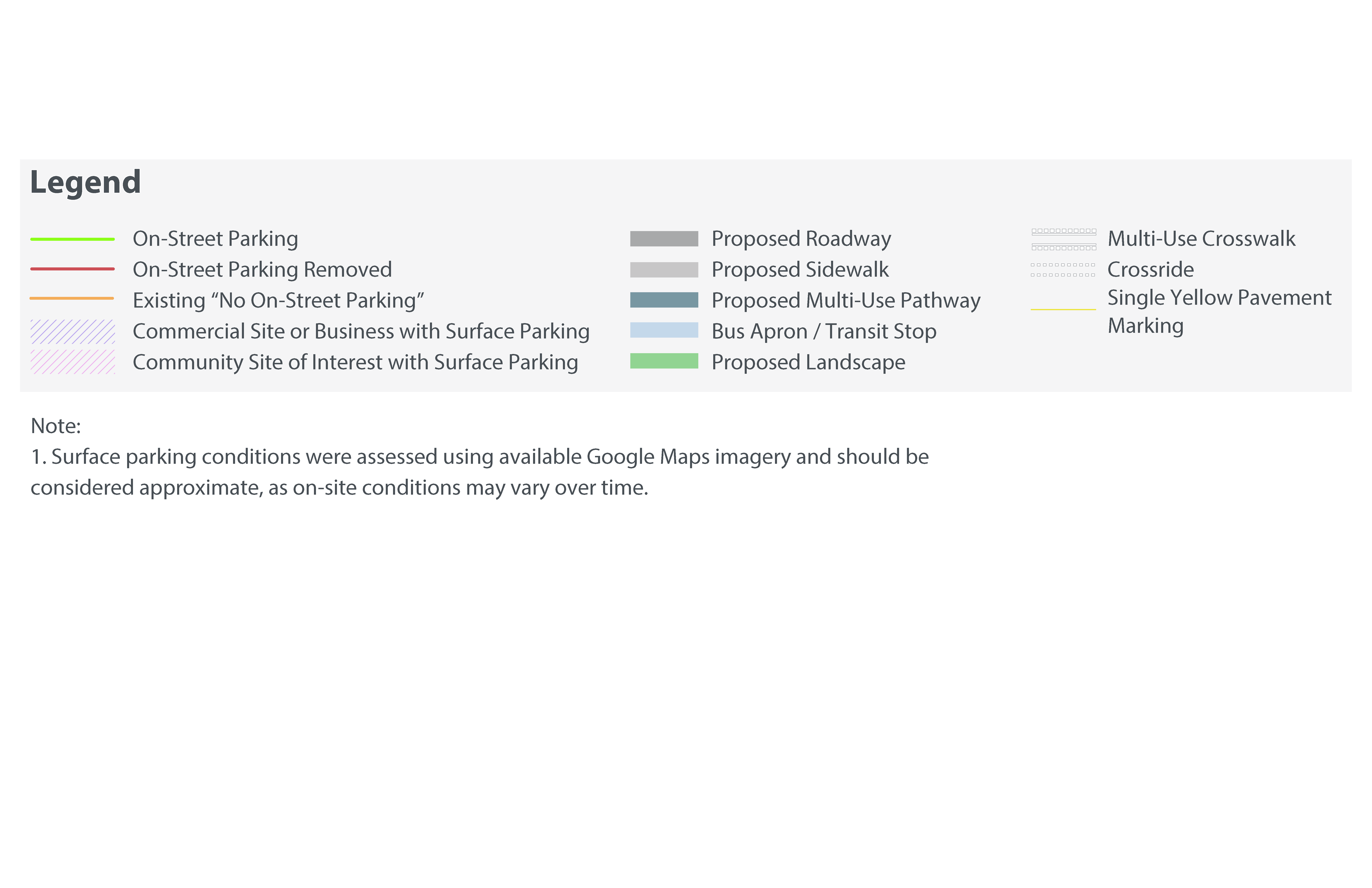
The map below shows permanent changes to on-street parking along 26 Avenue S.W. and alternative parking options in the area.

How will parking be addressed in the future?
Developers are responsible for ensuring their projects meet the future parking demands of their tenants as part of the development approval process. This includes planning and providing adequate parking spaces in compliance with all applicable permitting and approval requirements.
Underground utility work
Why is underground water utility work included as part of this project?
The City is taking this opportunity to proactively upgrade aging water and storm infrastructure on 26 Avenue S.W. between 14 Street S.W. and 18 Street S.W. while mobility improvements are underway.
- Water main replacements
The water main will be replaced between 14 Street S.W. and 15 Street S.W. and between 16A Street S.W. and 18 Street S.W. Replacing these aging water mains will help reduce the risk of unexpected breaks and service interruptions, helping ensure safe, reliable water service for the community. - Storm system improvements
The storm system will be upgraded between 16A Street S.W. and 17A Street S.W. Upgrading the storm system will improve how rainwater and snowmelt are managed, reducing pooling and drainage issues in the area.
Will the addition of the underground water utility work extend the construction timeline for the project?
Yes, including underground water utility upgrades as part of the project is expected to extend construction by a few months.
However, completing this work at the same time as the other improvements helps avoid future construction and repeat disruptions along the corridor. Coordinating the work into a single project reduces overall impacts to the community and makes more efficient use of City resources and funding.
Will water service be affected?
During underground water utility work, some properties long 25 Ave - 26 Ave S.W. between 19 St - 14 Street S.W. may experience temporary, short‑term water shutoffs. Should it be necessary to disrupt water service, all affected properties will receive notice in advance.
Depending on the length of the water shut off, some properties may receive temporary water services. These properties will receive advance notice.
Construction and impacts
When will construction happen?
Construction is expected to begin in summer 2026 and be completed in 2028.
Please note that timelines may shift due to factors such as weather, supply chain delays, or unexpected site conditions.
What happens if construction timelines change?
Weather, unforeseen site conditions, supply availability, or coordination with other work can impact a project’s timelines.
If timelines or impacts change, updates will be shared as soon as possible through this webpage, email newsletters, and construction notices.
Will construction last the whole time in front of my property?
No. To minimize disruption to the community, construction will be completed in short sections along the corridor. Crews will only be in front of a specific property for a limited time, rather than the full duration of the project.
Construction schedules and phasing plans will be shared with the community as soon as they are available, so you’ll know what to expect before work begins.
What impacts can I expect during construction?
During construction, you may experience:
- Increased noise, dust, and vibrations
- Temporary traffic lane closures, shifts and detours
- Temporary sidewalk closures and detours
- Temporary parking restrictions
- Tree pruning may be required for the safety of workers and to protect trees from accidental damage
The project team will provide advance notice of significant impacts and maintain access to homes and businesses throughout construction.
What is being done to help residents, businesses and commuters throughout construction?
We know construction can be disruptive, and we are committed to minimizing impacts as much as possible.
To help reduce disruption:
- Construction will be completed in short sections, rather than along the entire corridor at once. This helps limit long‑term impacts to individual properties.
- Access to homes and businesses will be maintained throughout construction.
- Two‑way traffic and safe routes for people walking, cycling and riding will be maintained as much as possible. If temporary detours are required, they will be clearly signed and designed to be as direct and accessible as possible.
- Construction will follow City noise bylaws. On rare occasions, if overnight or Sunday work is required, advance notice will be provided.
To help people stay informed throughout construction:
- Project updates will be shared on the project webpage and through email newsletters.
- Nearby properties will receive advance notice before work begins in their area.
Prefer a conversation? Schedule a virtual or in-person meeting with the project team.
We thank the community for their patience as we work to make the street safer for everyone.
Will construction occur on my property?
No. Construction will not take place on private property.
Most work will occur in existing sidewalk and roadway areas. In some locations, construction may reach the edge of the public right‑of‑way, but it will not extend onto private property.
If there are any temporary impacts to landscaping near the property line, those areas will be restored to their existing condition once construction is complete.
Snow clearing and maintenance
Who is responsible for clearing snow from the new multi-use pathway and protected bike lane?
Bike lanes
The City is responsible for clearing snow from bike lanes. Snow will be cleared promptly after snowfall ends to support safe, year-round cycling.
Multi-use pathways
We are currently clarifying whether snow clearing will be handled by The City or adjacent property owners. These discussions are ongoing, and we will provide an update to the community outlining roles and responsibilities once this has been confirmed.
Where should snow be stored next to the bike lane?
When clearing snow from sidewalks or pathways next to bike lanes, please:
- Do not pile snow in the bike lane. Piling snow in the bike lane creates hazards, forcing cyclists into traffic or slippery conditions.
- Keep storm drains clear to prevent drainage issues when snow melts.
For more details on property owner responsibilities and The City’s winter maintenance program, visit calgary.ca/snow. For information on sidewalk clearing, visit calgary.ca/shovel.
Contact us
Questions or feedback? Email us at 26AveSW@Calgary.ca.
Prefer a conversation? Schedule a virtual or in-person meeting with the project team.