

Bearspaw South Feeder Main replacement project
Supporting Calgary’s drinking water system Bearspaw South Feeder Main replacement project
Overview
The City is implementing a revised plan that urgently expedites construction of a replacement for the Bearspaw South Feeder Main (BSFM) due to the critical condition of the current pipe and its importance in Calgary’s drinking water system.
The project is adding a parallel steel pipe of the same size as the existing BSFM. Over time, this new pipe will take over service from the current line. The replacement pipe is anticipated to be completed in December 2026.
This work is an important investment in water infrastructure to support system reliability and reduce the risk of feeder main issues or failures.

Stage 4 Water Restrictions
Starting November 4, city-wide Stage 4 water restrictions will be in effect. No outdoor water use will be permitted during this time.
We're also urging Calgarians to reduce their indoor water use.
Project stages
The project is happening in two stages:
- Stage A: From the Shaganappi Pump Station to 73 Street N.W. on the west side of the Bow River.
- Stage B: Continues from 73 Street N.W. to 89 Street N.W., with a potential extension to the Bearspaw Water Treatment Plant.
2026 Bearspaw South Feeder Main Replacement Stages A & B
Contact
If you have questions or feedback about the project, we’d like to hear from you.
- Email: BSFMProject@calgary.ca
- Complete the Resident contact information form
- Call 311
Stage A construction
Construction for Stage A of the new Bearspaw South Feeder Main began in January using microtunnelling. This stage of the project will run from the Shaganappi Pump Station to 73 Street N.W., on the west side of the Bow River.
This approach was chosen because the pipe alignment includes significant crossings such as 16 Avenue, the Bow River and the CPKC rail line. While some surface work will still be required, work is largely happening at targeted locations instead of along the entire corridor.
Stage A project status
Project status as of September 24, 2026:
- Completed approximately 3.7 km of microtunnelling beneath existing infrastructure.
- Installation of the new steel feeder main and concrete carrier pipe between the Shaganappi Pump Station and 73 Street N.W. is complete.
- Crews continue work on valve chambers, pipe welding and supporting infrastructure to prepare the feeder main for service.
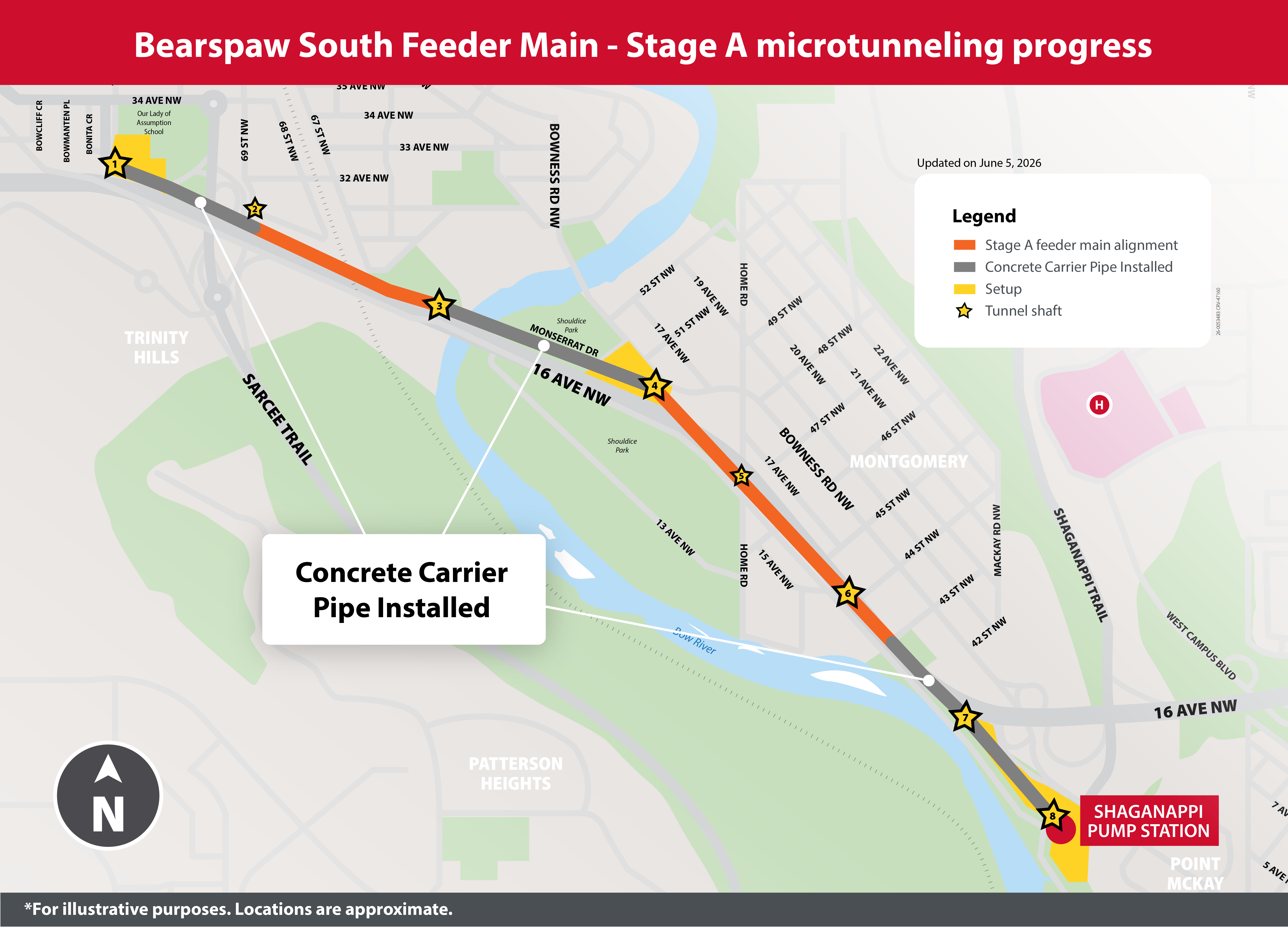

Image gallery
Microtunneling shaft under construction on February 27, 2026. This shaft will be used to microtunnel Stage A of the new Bearspaw South Feeder Main.
Stage A of the Bearspaw South Feeder Main replacement project is being completed using microtunneling. This image shows the construction of a microtunneling shaft beside 16 Avenue N.W. at Edworthy Park on February 27, 2026.
Construction of microtunneling shafts for Stage A of the Bearspaw South Feeder Main replacement project is underway. This image from February 27, 2026, shows progress on a microtunneling shaft at Edworthy Park next to 16 Avenue N.W.
Image from March 12, 2026, shows construction progress on the Bearspaw South Feeder Main Stage A microtunneling shaft beside 16 Avenue N.W. just east of the exit to 29 Avenue N.W.
Stage A of the Bearspaw South Feeder Main replacement project will be completed using microtunneling. This image from March 12, 2026, shows construction progress on a microtunneling shaft along 16 Avenue N.W.
Stage B construction
Stage B construction for the Bearspaw South Feeder Main replacement project started May 11, 2026, and is expected to continue through November 2026. The new replacement pipe will run from 73 Street N.W. to 89 Street N.W., where it will connect to the existing steel pipe leading to the Bearspaw Water Treatment Plant. Extending the pipe to 89 Street N.W. helps avoid future construction and reduces future community disruptions.
Work started with cross-connection construction the week of May 11 at 77 Street N.W. and 83 Street N.W., and we are now installing the new steel feeder main along 34 Avenue N.W.
Stage B is being installed using an open‑cut construction approach, which allows work to be completed more efficiently and shortens the overall construction timeline. Construction is being completed in sections, with crews generally working east to west along 34 Avenue N.W. Multiple crews are active at the same time, and each work area is expected to take approximately 10 to 12 weeks to complete.
Stage B project status
Project status as of September 24, 2026
- Construction along 34 Avenue N.W. in Bowness remains on schedule.
- More than 1.6 km of steel feeder main pipe has been installed, representing approximately 61% of the Stage B alignment.
- Pipe installation is complete on 7/13 blocks, with work underway on three additional blocks.

Stage B open-cut construction on 34 Avenue N.W., July 10, 2026
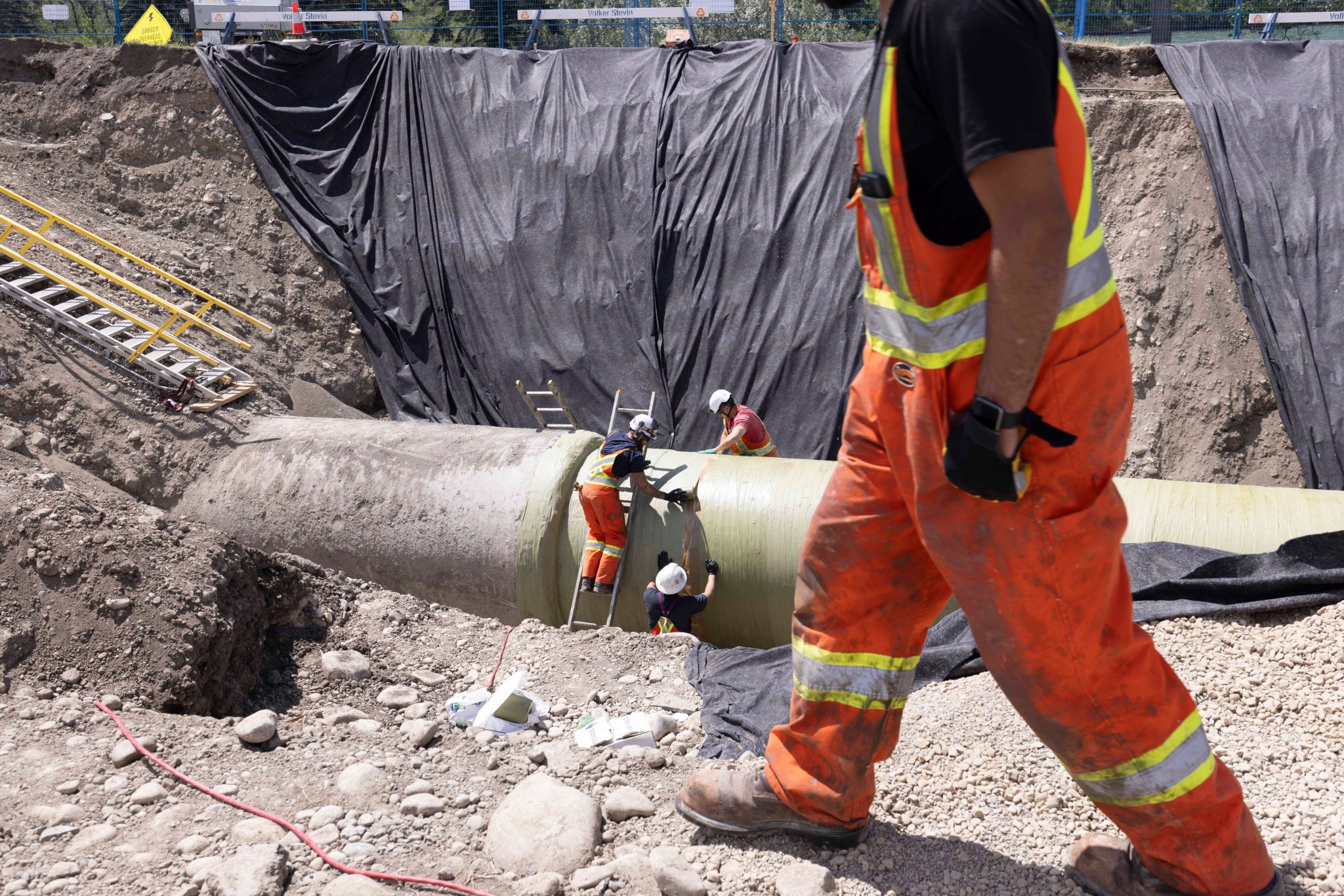
Steel pipe being delivered and installed for Stage B of the Bearspaw South Feeder Main replacement project.
Steel pipe being delivered and installed for Stage B of the Bearspaw South Feeder Main replacement project.
Steel pipe being delivered and installed for Stage B of the Bearspaw South Feeder Main replacement project.
July 28, 2026, images shows open cut construction and steel feeder main installation in Bowness on 34 Avenue N.W.
July 28, 2026, images shows open cut construction and steel feeder main installation in Bowness on 34 Avenue N.W.
Stage B construction process
- Crews will be excavating within the public right-of-way to install utilities for the replacement feeder main. This work will be done using an open-cut method.
- Step 1: Pre-construction work such as tree pruning/removal and signage removal.
- Step 2: Road will be closed, fencing will be put up, detours will be put in-place.
- Step 3: Asphalt cutting will begin to remove surface materials.
- Step 4: Excavation to reveal existing utilities and dig out pipe trench.
- Step 5: Relocation and Installation of new utilities
- Step 6: Backfill & paving
- Step 7: Community restoration
What to expect
- Crews will be working Monday - Saturday 6:30a.m. – 9p.m, Sunday as required. These hours have shifted and may change again, subject to project schedule needs.
- Construction vehicles around work areas.
- Traffic impacts and detours. Temporary street parking impacts.
- When construction begins in a specific area, that entire area will be closed to traffic and parking.
- Driveway access may be impacted for some residents. City representatives will be reaching out to impacted property owners directly.
- Fenced areas for equipment and supplies.
- Noise, dust and vibrations.
- There are NO planned water, gas, or electric outages, but temporary shutoffs may be required.
Potential tree & property impacts
During Stage B construction, some trees and shrubs in and near the public right‑of‑way may be affected.
The public right‑of‑way often extends beyond the paved road and can include areas that look like part of a private yard. Ahead of construction, our team conducted a detailed inventory and health assessment of all trees and shrubs within the public right‑of‑way, including those nearby or overhanging into the right-of-way.
What to expect
- Tree pruning may be needed where branches extend into the public right‑of‑way.
- All trimming and removals will be completed only when needed and as construction moves from one work area to the next. This approach helps minimize unnecessary impacts.
How work will be done
- If a tree on or near your property is impacted, a member of our team will contact you directly.
- All tree work will be carried out by qualified City arborists or professional tree removal contractors.
- All landscaping restorations are covered by a two‑year warranty (two growing seasons).
Sidewalk Improvements on 34 Avenue
As part of the Bearspaw South Feeder Main (BSFM) replacement project, sidewalks along 34 Avenue N.W. between 73 Street and 89 Street will be widened from 1.2 metres to 1.5 metres. The wider sidewalks will improve accessibility and pedestrian safety while aligning with the standards used in newer communities. A short section between 73 Street and 77 Street will remain at its current 1.2-metre width to maintain consistency with the sidewalk on the opposite side of the street, which is not being reconstructed as part of this project.
The sidewalk improvements will be accommodated within the existing public right-of-way and will not reduce roadway width or affect vehicle travel lanes. While every effort will be made to minimize impacts, some residents may experience temporary changes within the public right-of-way adjacent to their property, including the relocation of street lights, additional trimming of trees and shrubs, or impacts to privately installed irrigation systems and landscaping located within the public right-of-way. Project team members will contact affected residents directly to discuss any anticipated impacts before construction begins.
Outreach and information
We recognize the impact of the 2024 and 2025 feeder main breaks to businesses and communities and the importance of timely, considerate communications so you know what's happening.
Over the coming weeks and months, we are committed to continuing to work closely with the community to provide information and details of construction activities, address unique needs of individual residents and support mitigation efforts where practical.
Construction communications process
| Timing | What to expect |
|---|---|
| Timing: 6-8 weeks ahead of construction |
What to expect:
|
| Timing: 3-6 weeks ahead of construction |
What to expect:
|
| Timing: 2 weeks ahead of construction |
What to expect:
|
| Timing: During construction |
What to expect:
|
Stay informed
Please complete the resident contact form to receive regular project updates and information regarding construction.
You can also view the latest City of Calgary news releases.


